

Walk a tower-top tech through any 123eWireless inventory page and they will, without thinking, read the suffix on the part number. The end-letters tell them whether the connector is screwed (S, for SMA) or quick-mated (Q, for QMA). The cable behind it is identical. The electrical performance, across the cellular bands the parts were designed for, is comparable. And yet on the install, the two parts behave like cousins from different households.
That is the whole story of SMA versus QMA: same electrical envelope, different mechanical philosophy. If you understand the philosophy, the choice between them stops feeling like a coin flip and starts feeling like a tool selection.
The lineage
SMA — the SubMiniature version A — has been on engineering benches since the early 1960s. It was designed when the dominant interconnect concern was repeatability: a precision-machined threaded interface, hand-torqued to a published value (typically 8 in-lb on stainless), gave you a 50 Ω impedance you could trust and verify on a network analyzer. SMA earned its place in test labs, military hardware, GPS receivers, and any application where the cable was going to be mated, torqued, and forgotten.
QMA — the Quick-Mate version A — is much younger. It was developed in the early 2000s by an industry consortium that watched the cellular base-station boom and noticed something specific: a tower technician was spending real time threading and unthreading SMAs in cabinets that already had a hundred other things to do. The QMA brief was simple: keep the SMA's electrical performance, lose the threads. Push to mate. Pull a sleeve to release. No torque wrench. No counting turns. No cross-threaded female contacts at the bottom of a fully populated panel.
Where they are the same
Both connectors are 50 Ω nominal, both use a PTFE dielectric, and both are standardized as part of the IEC 61169 family (SMA in -8 / -10, QMA in -35). Across the cellular bands they were designed for — sub-6 GHz — their VSWR and insertion loss are comparable. In a 123e jumper, swapping an SMA-male end for a QMA-male end on the same cable does not change the cable's intrinsic performance; what changes is the connector interface itself.
| Spec | SMA | QMA |
|---|---|---|
| Characteristic impedance | 50 Ω | 50 Ω |
| IEC standard | IEC 61169-8 / -10 | IEC 61169-35 |
| Frequency range (typical) | DC – 18 GHz | DC – 6 GHz (extended-range to 18 GHz) |
| VSWR (straight, sub-6 GHz) | ≤ 1.20:1 | ≤ 1.25:1 |
| Dielectric | PTFE | PTFE |
| Center-pin plating | Gold over copper | Gold over copper |
If the only thing you read on a datasheet is the electrical block, the two parts look interchangeable. They are not.
Where they are different
The difference lives in everything around the electrical: how the connector mates, how it stays mated, how fast you can install it, and how many times it can come on and off before the contact resistance drifts.
| Property | SMA | QMA |
|---|---|---|
| Mating mechanism | Threaded coupling (1/4″-36 UNS) | Push-on, snap-lock; sleeve-released |
| Install time per mate | ~10 – 20 s (with torque wrench) | < 1 s |
| Tooling required | Torque wrench (8 in-lb stainless) | None |
| Mating cycles (typical) | 500 – 1,000 | ~100 (consult datasheet for the specific build) |
| Vibration / shock | Excellent (threads stay engaged under load) | Good (snap-lock holds; verify per build) |
| Density on a panel | Lower — thread access requires clearance | Higher — mates straight in |
| Cross-thread / over-torque risk | Real, especially in cabinets | None |
| Audit / repeatability | Torque value is documentable | Audit by visual snap + pull test |
When SMA still wins
SMA is the right call when:
- The interface mates once and stays mated. Test fixtures, sealed enclosures, GPS receivers on a roof, anything the user is not expected to touch again. The thread is the right answer because the thread is permanent.
- Vibration is severe. Avionics, military hardware, and engine-mounted instrumentation buy what threads give you: a connection that does not get loose because something nearby is shaking.
- Documentable torque is part of the QA spec. A torque wrench leaves a paper trail. A push-on does not.
- The technician will be working at a bench, not in a cabinet. When access is unconstrained, the time penalty for threading is not a real cost.
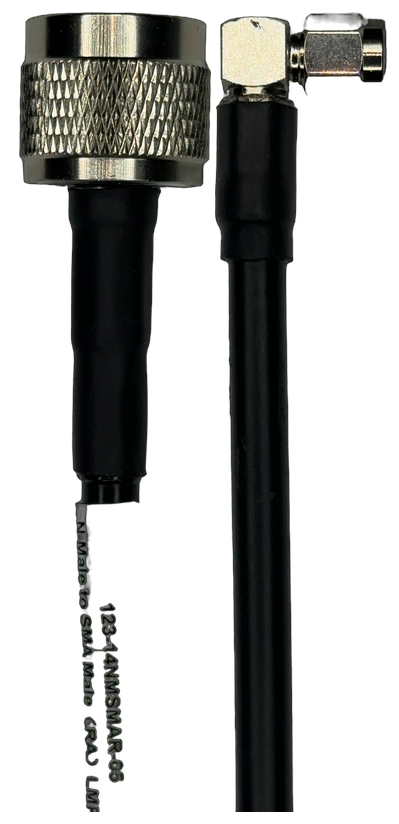
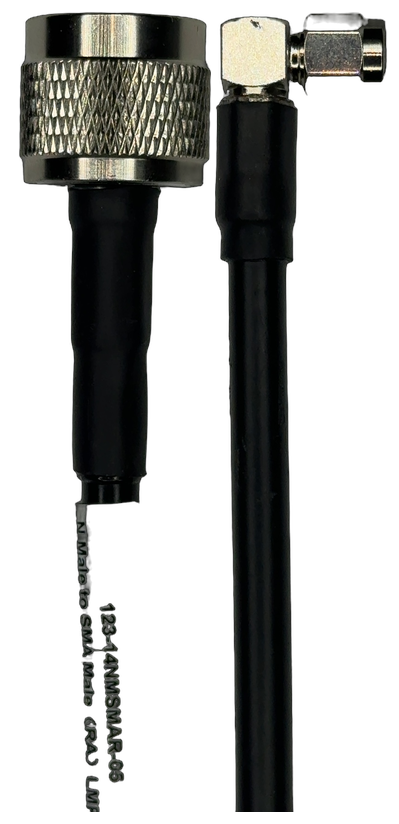
Three sizes of carrier-grade SMA jumpers we ship same-day. Built on Low-Loss 240 braided cable, hand-terminated, sweep-tested. Click any card to see the full datasheet and order.
When QMA earns its place
QMA is the right call when:
- Density matters. Modern radio cabinets and combiners pack connectors so tight that threading an SMA means turning a wrench in a space the size of a quarter. QMA mates straight in.
- The interface gets touched repeatedly during commissioning. Tower techs swap radios, swap antennas, sweep, and re-mate. Each of those operations is faster on QMA, and the tech is less likely to leave one a quarter turn loose because the radio above it is in the way.
- Cross-threading is the dominant failure mode. If your install crew has been finding female SMA bodies with damaged threads, QMA removes the failure mode entirely — you cannot cross-thread something that does not have threads.
- Same-day installs in the field. The economics of a tower climb make every saved minute on the deck money in the bank.
QMA-finished jumpers are a custom build at 123eWireless. Pick cable, length, and the second connector in the configurator and we'll quote in one business day — volume runs ship in our standard custom lead time.
The 123e PN suffix is the mnemonic
On 123eWireless part numbers, the connector-end suffix is a single letter. It encodes the mating philosophy directly:
S→ SMA — screwed. Threaded, torque-wrench friendly.Q→ QMA — quick. Push-pull, snap-lock.
So 123-14NMSMAMR-3 is a Low-Loss 240 jumper with an N-Male on one end
and an SMA-Male Right Angle on the other. Swap the suffix to a QMA equivalent
and you have the same jumper with a quick-mate connector on the radio side. The
cable, the build, the test report, the box on the shelf — all identical until
you get to the connector itself. The PN tells you which mating philosophy you are
buying without having to dig into the datasheet.
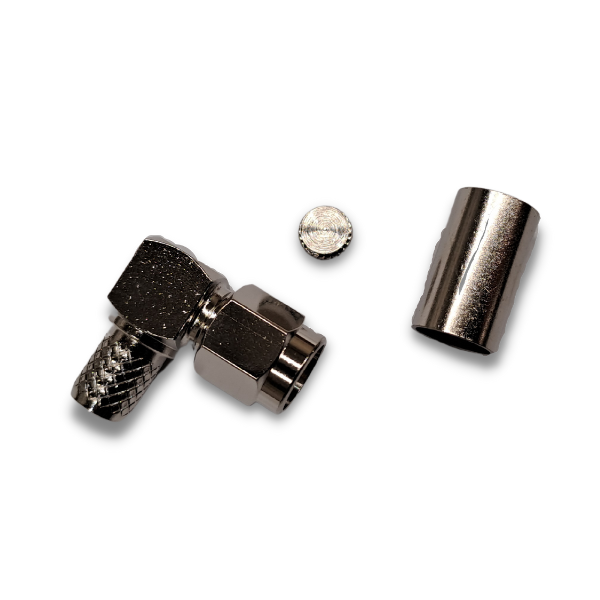
Building your own jumpers? The SMA connector below is the same one we use on our finished assemblies, sold individually for in-house termination.
Because they share an electrical envelope, our engineering team treats SMA and QMA as one row on the design-review checklist with two mechanical variants. We do not spec one as a substitute for the other — we spec the one whose mechanical properties match the install. That is the only question worth asking.
A field-decision checklist
When your build is ambiguous, work through these questions in order. The first one that gives a clear answer is your answer.
- Will this interface be mated more than ~50 times in service? → SMA (mating-cycle margin).
- Is the cabinet density such that a torque wrench will not fit? → QMA.
- Is documented torque part of the QA package? → SMA.
- Do field techs report cross-threading or over-torque damage? → QMA.
- Is vibration severe (avionics, engine-mount, vehicle)? → SMA.
- Otherwise — tower install, commissioning, swap-friendly — default to QMA for time saved on the deck.
Bottom line
SMA and QMA are not competing connectors. They are two answers to the same electrical question, optimized for different mechanical realities. SMA wins when permanence and documentation matter most. QMA wins when speed and density matter most. Choose the one whose mechanical philosophy matches the install, buy the part with the right PN suffix, and stop worrying about whether the electrical specs match. They do.
Same thing. Different thing. The same but different.