
Programs · EV Charging Build-Outs
Tesla Supercharger · Target & retail-host programs · NEVI corridors
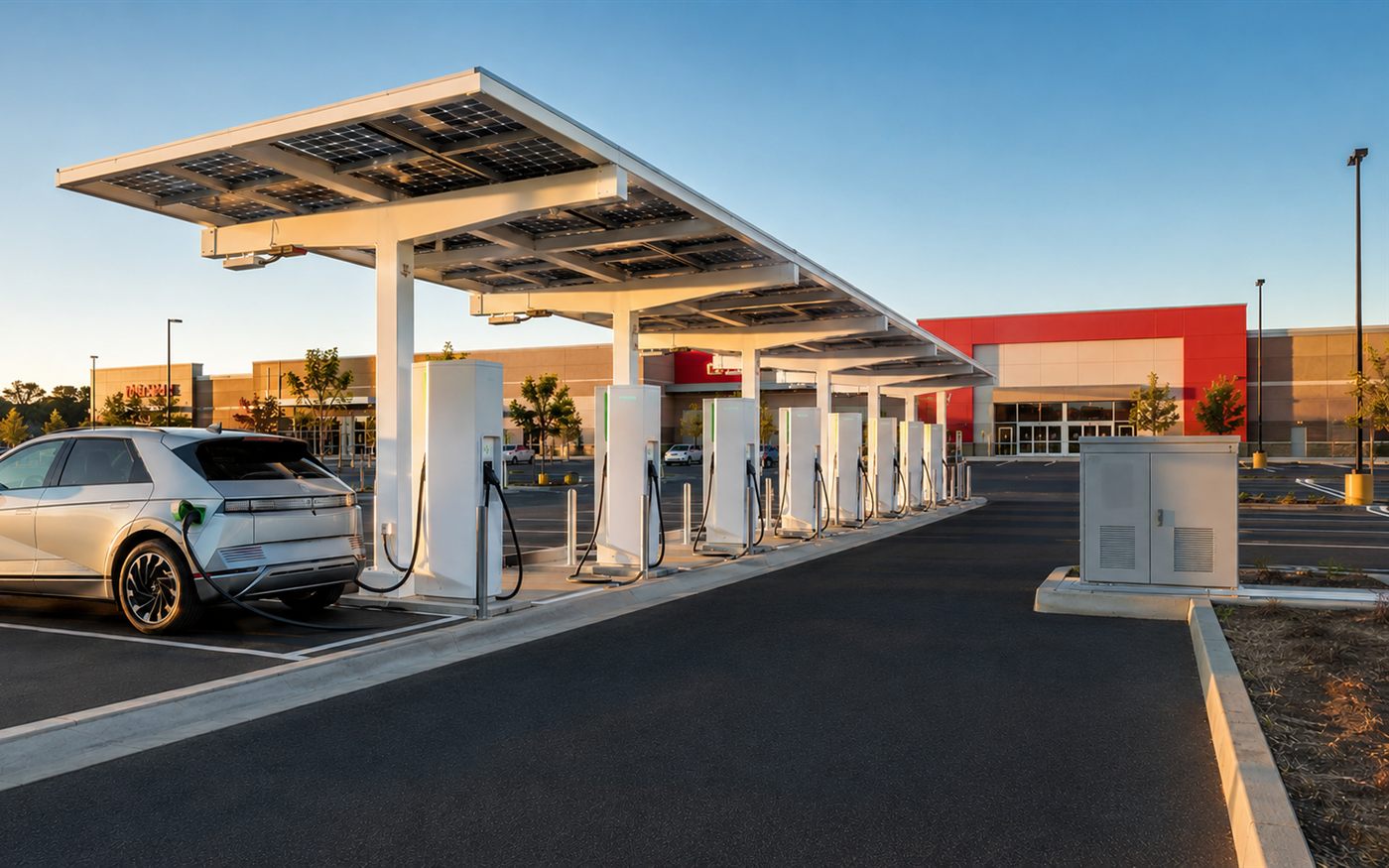
Every DC fast-charge pad is a networked device. A charger that cannot reach its network cannot authorize a session, report its status, or take a remote reset — to the driver and to the program scorecard, an offline charger is a broken charger. The communications path from the site to the charging network is build-out infrastructure in its own right, engineered and inspected like the switchgear and the conduit.
For federally funded sites the bar is written down: 23 CFR 680.116(b) requires every NEVI-funded charging port to average greater than 97% annual uptime, and requires chargers to support remote monitoring, diagnostics, control, and secure network communication. Uptime is a scored deliverable, and uptime runs on the comm path — state NEVI programs put “conduit and trenching for network connectivity” directly in the site scope.
The typical site design runs fiber from the site communications cabinet to the charger pads, with a cellular link as the backup path (cellular is also the default backhaul where fiber has not reached the site). That gives the build two distinct material scopes: the fiber run, and the RF side that keeps the backup path alive.
Contractors spec the pad run in language like “OptiTap®-compatible preconnectorized drop, SC/APC hardened connector, flat drop, tonable, dielectric” — a factory-terminated assembly with a hardened, environmentally sealed connector that plugs straight into the terminal or demarc. Against field termination, the preconnectorized drop removes the splice crew and the splice trailer from the critical path: the run is pulled, plugged, and tested the same day, and the factory termination arrives with measured insertion loss instead of a field-dressed unknown.
The connector at the pad is hardened for a reason: the last meters live in handholes, pedestals, and cabinet entries — wet, dirty, and opened by whoever services the site next. OptiTap®- and Pushlok®-compatible hardened interfaces are rated for exactly that environment, on drop constructions from SST-Drop flat drop to ROC 900 round cable. Typical site drops run long: distributor stock for charging-site drops is sized from 250 ft up to 1,100 ft, with the demarc-to-cabinet run set by where the serving terminal landed, not by a catalog length. Between cabinets and under the pad — often in shared conduit — the same builds pull armored duplex LC assemblies, and the conduit entries themselves get sealed with duct plugs and entry port caps.
The cellular backup path is its own small RF install: a multiband antenna (IP67, typically 600 MHz–6 GHz with GNSS) on the comm cabinet or canopy, fed through low-PIM coax jumpers — LMR-240/LMR-400-class runs with N, SMA, or 4.3-10 interfaces cut to the site's length. Every external antenna feed picks up a surge arrester and grounding to the site ground ring, and every outdoor coax connection gets weatherproofed. Small hardware, but it is the path the site falls back on when the fiber is cut — the uptime clause does not pause for a backhoe.
The assembly these builds run on, in every length live in the catalog — each card is the live catalog listing. Any other length is made to order. The catalog links below are our broader EV-site connectivity range; they are not part of the Tesla spec.
Talk to an engineer about the site design — same-business-day turnaround on most quotes.
Talk to an engineer →